
Best CD Rates of 2026: Top Yields by Term
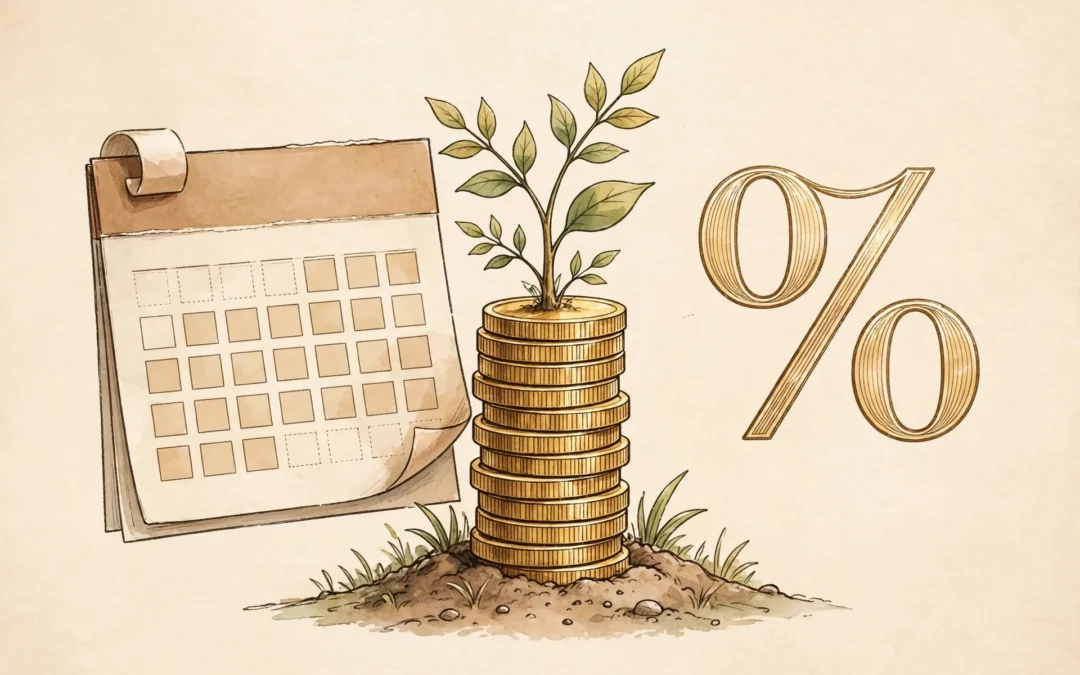
A certificate of deposit (CD) is a savings account that pays you a fixed interest rate in exchange for agreeing to leave your money untouched for a set period, from a few months to several years. If you can park cash you will not need soon, CDs remain one of the simplest ways to earn a guaranteed return — and as of mid-November 2026, the best CD rates still reach 5.00% APY, far above the national average. (See also our types of bank accounts guide.)
The rate environment has cooled, though. CD yields peaked in late 2023 and have drifted downward since, particularly after the Federal Reserve cut its benchmark rate three times in late 2025. Rates held broadly steady through most of 2026 — then on September 16 the Fed raised its benchmark 25 basis points to 3.75%–4.00%, its first hike since July 2023. With the rate path uncertain again, the trend favors locking in a competitive yield sooner rather than waiting. Below is a snapshot of where CD rates stand this month, which institutions are paying the most, and how to use CDs strategically.
November 2026 update: this guide was fully refreshed on November 18, 2026, and the October rate table below has been replaced with Bankrate’s November snapshot (APYs as of November 17, 2026). The top five-year yield eased from 5.20% in early October to 5.00% — Raymond James Bank, October’s leader, no longer tops Bankrate’s November list. The Federal Reserve held its benchmark rate at 3.75%–4.00% at its October 28 meeting, so the rate outlook behind this guide is unchanged. Rates move frequently, so always confirm the current APY on the bank’s official website before opening an account.
CD Rates by Term: November 2026 Snapshot
The gap between what the average bank pays and what the best online banks and credit unions offer is wide. Bankrate’s survey as of November 17, 2026, puts the national average at 2.13% APY for a one-year CD, 1.90% for a two-year CD, 1.74% for a three-year CD, and 1.79% for a five-year CD — essentially unchanged from October. The top nationally available yields run roughly double the national average at every term, so shopping around still pays.
The table below shows the top APY ranges currently advertised for popular terms, based on Bankrate’s November 2026 rate roundup (APYs updated November 10–16, 2026):
| CD term | Top APY range (Nov 2026) | National average APY* |
|---|---|---|
| 6 months | 4.30% – 4.40% | n/a |
| 1 year | 4.60% – 4.65% | 2.13% |
| 2 years | 4.60% – 4.76% | 1.90% |
| 3 years | 4.75% – 4.85% | 1.74% |
| 5 years | 4.80% – 5.00% | 1.79% |
*National averages from Bankrate’s survey, November 17, 2026 (a 6-month national average was not published). Top ranges reflect the highest nationally available yields in Bankrate’s November 2026 roundup (APYs updated November 10–16, 2026). Rates change frequently — always confirm on the institution’s official site before opening an account.
Six Competitive CD Providers to Compare
Online banks and select credit unions consistently pay the highest CD rates because they operate without expensive branch networks. Here are six widely available providers with competitive lineups this month. Rates below are from Bankrate’s November 2026 roundup (APYs as of November 17, 2026) and will change:
1. Quorum Federal Credit Union
- Standout rates: 5.00% APY on a 5-year certificate; 4.50% on 1-year; 4.40% on 6-month (Bankrate, November 17, 2026).
- Minimum deposit: $100 — the lowest minimum among the top-yielding 5-year CDs.
- Good to know: Anyone can join this credit union, and its certificates run from three months to five years — a strong pick for locking in the top 5-year yield without a large deposit.
2. Sallie Mae Bank
- Standout rates: 5.00% APY on a 5-year CD; 4.75% on 3-year; 4.60% on 1-year (Bankrate, November 17, 2026).
- Minimum deposit: $2,500.
- Good to know: Offers terms from six months to five years, including some lengths other banks do not carry — the 3-year rate is among the best available.
3. Popular Direct
- Standout rates: 5.00% APY on a 5-year CD; 4.85% on a 3-year CD (Bankrate, November 17, 2026).
- Minimum deposit: $10,000 — geared toward savers with larger balances.
- Good to know: Offers eight CD terms from three months to five years, which works well for ladder strategies — but the high minimum keeps it out of reach for smaller savers.
4. BTG Pactual Bank
- Standout rates: 4.85% APY on 3-year and 4-year CDs; 4.65% on a 1-year CD (Bankrate, November 17, 2026).
- Minimum deposit: $500.
- Good to know: Also offers a 13-month no-penalty CD — withdraw early without a fee — and standard terms from three months to five years.
5. Synchrony Bank
- Standout rates: 4.80% APY on a 5-year CD; 4.60% on a 15-month CD (Bankrate, November 17, 2026).
- Minimum deposit: $0 — no minimum to open.
- Good to know: Also offers bump-up CDs (one rate increase during the term) and IRA CDs, useful if you think rates might rise. Its 5-year yield rose from 4.50% in October to 4.80% in November — the rare top rate that moved up.
6. Marcus by Goldman Sachs
- Standout rates: 4.50% APY on a 1-year CD; 4.60% on a 2-year CD (Bankrate, November 17, 2026).
- Minimum deposit: $500.
- Good to know: Offers no-penalty CDs (withdraw the full balance after a brief holding period with no fee) and a 10-day rate guarantee — if the rate rises within 10 days of opening, you get the higher one.
How a CD Ladder Works
If you do not want to bet on where rates are headed, a CD ladder spreads your money across several CDs with staggered maturities. Here is a simple example with $20,000:
- Put $5,000 each into 1-year, 2-year, 3-year, and 4-year CDs.
- When the 1-year CD matures, reinvest it into a new 4-year CD at the prevailing rate.
- Repeat each year. After four years, you hold four 4-year CDs maturing one year apart.
The ladder gives you two advantages: part of your money frees up every year (liquidity), while most of it still earns long-term rates (yield). If rates rise, maturing rungs get reinvested at the new higher rates; if rates fall, most of your money is already locked in. It is the standard strategy for uncertain rate environments — which describes 2026 well.
Early Withdrawal Penalties: What They Cost
The trade-off with CDs is the early withdrawal penalty. Pull money out before maturity and the bank typically forfeits a set amount of interest — commonly 90 days’ interest on CDs of one year or less, and 180 to 270 days’ interest on longer terms. For example, Bankrate notes E*TRADE charges 270 days’ interest on its three-year CD.
Two things to know. First, if you have not earned enough interest to cover the penalty, the bank can take the remainder from your principal — the rare case where a CD can “lose” money. Second, most CDs include a grace period (usually 7–10 days) at maturity when you can withdraw or change terms penalty-free; if you do nothing, many banks automatically renew into a new CD at the current rate. Mark your maturity dates so a renewal does not lock you into a rate you did not choose.
If flexibility matters more than the absolute highest yield, consider a no-penalty CD (offered by Marcus, Ally, and others): you can withdraw the full balance after a brief initial period with no fee, at the cost of a slightly lower APY.
If you want full flexibility with a rate that stays competitive, a money market account is the middle ground: no lock-up, check-writing and debit access, and top yields around 4.00%–4.05% APY. Our money market rates guide compares money market yields with CD rates and explains when each option wins.
CD vs. Money Market Accounts vs. Treasury Bills: Where a CD Wins
A CD is only one of three places savers park cash they do not need immediately, and each wins in a different situation. A money market account pays a variable rate — top yields sit around 4.00%–4.05% APY — but lets you withdraw, write checks, and use a debit card, so it suits money whose timing is uncertain. Treasury bills are short-term government securities, typically four to fifty-two weeks, bought through TreasuryDirect or a brokerage; their yield moves with the market rather than locking in, and their interest is exempt from state and local tax, which matters in high-tax states. A CD beats both only when you know you will not need the money before maturity and you want the rate fixed for the full term.
| Option | Rate | Access | Best for |
|---|---|---|---|
| Certificate of deposit | Fixed for the term | Locked until maturity (penalty for early withdrawal) | Money with a known time horizon |
| Money market account | Variable, moves with rates | Withdrawals, checks, debit access | Cash that may be needed soon |
| Treasury bills | Set at auction, short terms | Matures in weeks to a year; sellable through a broker | Short-term cash, especially in high-tax states |
The practical split for most savers is simple: emergency fund in a liquid account, money with a date attached — a house deposit in two years, a tuition bill next fall — in CDs or a ladder. Our money market rates guide compares money market yields with CD rates in detail.
How to Pick a CD Term Now That the Fed Is on Hold
With the Fed holding at 3.75%–4.00% after its October meeting, there is no strong signal pushing savers toward very short or very long terms — which makes the choice a matter of timing, not forecasting. Money you might need within a year does not belong in a standard CD at all; a no-penalty CD or a money market account fits better. Money with a one- to three-year horizon is the sweet spot for a standard CD or the first rungs of a ladder: you lock a competitive rate without betting on where rates sit five years out. Five-year CDs only make sense for money you are confident you will not touch, since the early withdrawal penalty on a long term can erase months of interest. The common mistake is reaching for the highest advertised APY regardless of term; the right term is the one that ends when you actually need the money.
Brokered CDs and No-Penalty CDs: The Flexible Alternatives
Not every CD comes from a bank’s own website. Two variants solve the problems a traditional CD creates — being locked in, and being stuck with one bank’s rates.
Brokered CDs are bought through a brokerage — Fidelity, Schwab, and Vanguard all sell them — rather than directly from a bank. The issuing bank is still FDIC-insured (up to $250,000 per bank, per depositor), and you can spread a large balance across several banks inside one brokerage account. The trade-off is liquidity: there is usually no early-withdrawal penalty, but if you sell before maturity you sell on the secondary market, and the price can come in below what you paid if rates have risen. Brokered CDs suit savers who want to shop many banks at once and are comfortable holding to maturity.
No-penalty CDs are the simpler flexibility play: you can withdraw the full balance after a brief initial holding period (often seven days) with no fee. Marcus by Goldman Sachs and Ally both offer them, and BTG Pactual offers a 13-month no-penalty CD. The cost is a slightly lower APY than a locked CD of the same term. Choose a no-penalty CD when the money’s timing is uncertain — a house deposit that might close in three months or nine — and a traditional CD when the date is fixed.
Frequently Asked Questions
Are CDs safe?
Yes. CDs from banks are insured by the FDIC, and those from credit unions by the NCUA, up to $250,000 per depositor, per institution, per ownership category. As long as you stay within those limits and hold to maturity, your principal and promised interest are guaranteed.
Are CD rates going up or down?
Down from their peak, broadly. Top CD yields hit their high in late 2023, then eased as the Federal Reserve cut its benchmark rate three times in late 2025. Through most of 2026 the Fed held rates steady while competitive CD yields inched lower — then on September 16 the Fed raised its benchmark 25 basis points to 3.75%–4.00%, its first hike since July 2023. With inflation around 3.4% annually as of July 2026 (per Bankrate), locking in 4–5% APY still protects purchasing power — but waiting for higher rates has been a losing bet for two years, and the top five-year yield has already eased from 5.20% in early October to 5.00% in mid-November.
CD or high-yield savings account?
A high-yield savings account keeps your money liquid and its rate floats with the market; top online savings accounts pay roughly 3.75% APY in November 2026. A CD locks your rate for the term, which wins if rates fall — but costs you flexibility. Many savers hold both: savings for the emergency fund, CDs for money with a known time horizon. Compare the high-yield savings accounts we recommend.
Do I pay taxes on CD interest?
Yes. CD interest is taxed as ordinary income in the year it is credited, even if you leave it in the CD. Your bank will send a Form 1099-INT if you earn $10 or more. Interest in a CD held inside an IRA follows IRA tax rules instead. For tax-advantaged retirement savings, learn how a Roth IRA works.
Should I lock in a CD now or wait for higher rates?
Waiting has been a losing bet for two years: top yields have drifted down from their late-2023 peak, and the Fed’s October decision to hold rates at 3.75%–4.00% gives no reason to expect a jump. If the money has a known time horizon, locking a competitive rate now protects you if rates fall, and a ladder keeps part of your money freeing up each year if they rise. Waiting only pays if you have a concrete reason to expect higher rates — and a general hope that they might rise is not one.
A Note on Rates and Advice
CD rates change frequently — sometimes daily — and can vary by region, balance tier, and promotional period. Every rate in this article reflects figures published by Bankrate or the institutions themselves in mid-November 2026; always verify the current APY, minimum deposit, and early withdrawal penalty on the bank’s official website before opening an account. This article is for informational purposes only and is not financial advice. Consider speaking with a qualified financial professional about what is right for your situation.
Last reviewed: November 18, 2026. Rate figures in the table are Bankrate’s November 2026 snapshot (APYs as of November 17, 2026); see the November update note above.